When developing an X-ray imaging, inspection, analytical, or non-destructive testing system, OEM engineers must decide how to integrate the X-ray source. One option is to use a packaged X-ray tube with a separate high-voltage power supply. Another is to select an integrated X-ray generator for OEM applications that combines the x-ray tube, high-voltage power supply, and control electronics into one coordinated assembly.
Both architectures have valid uses. However, an integrated X-ray generator can offer important advantages for OEM system design, including simpler electrical integration, more efficient packaging, fewer interfaces, and a streamlined development process.
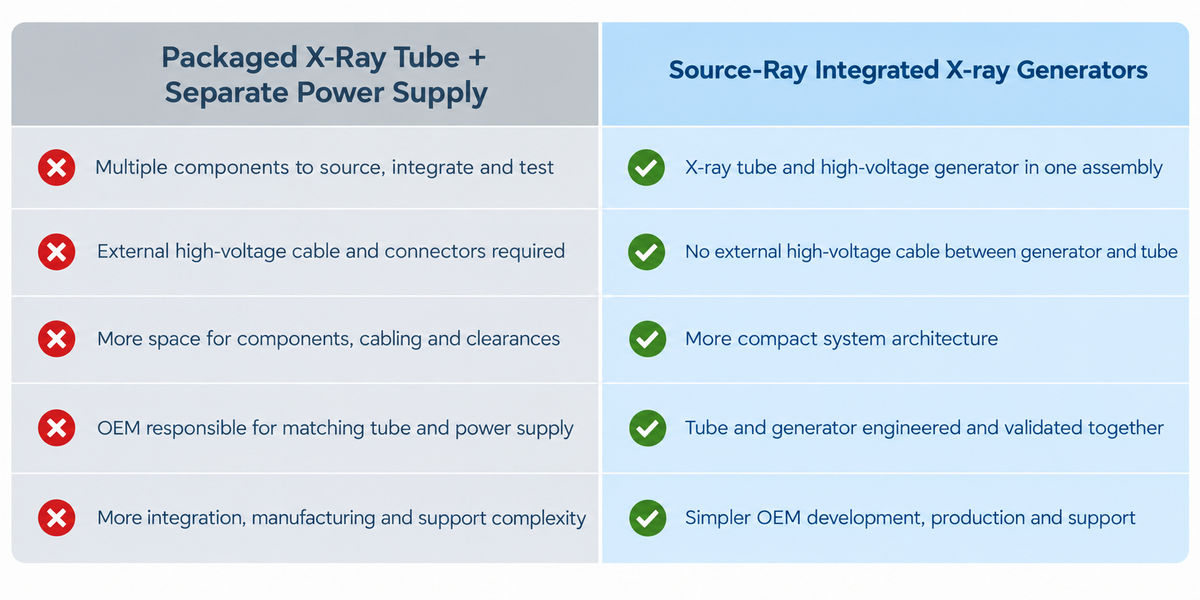
An integrated X-ray generator combines the X-ray tube, high-voltage power supply, filament supply, and associated control electronics into a coordinated assembly. This can eliminate many of the interfaces required when an OEM independently integrates a tube, high-voltage power supply, high-voltage cabling, connectors, and related components.
For OEM engineers evaluating their next X-ray platform, here are five reasons to consider an integrated X-ray generator.
1. Eliminate External High-Voltage Cabling Between the Generator and X-Ray Tube
One of the most significant differences between an integrated X-ray generator and a traditional discrete architecture is the high-voltage connection.
With a separate X-ray tube and high-voltage power supply, high voltage must be carried from the generator to the tube through specialized high-voltage cables and connectors. Depending on the system architecture, these connections can operate at tens or even hundreds of kilovolts.
High-voltage cables are not electrically invisible. They introduce capacitance into the high-voltage circuit and therefore store electrical energy.
This becomes particularly important during an arc event.
Technical literature on high-voltage power supplies notes that cable capacitance can contain significant stored energy. During an arc, that energy can discharge through the high-voltage circuit and contribute to high transient currents and voltage ringing. For this reason, minimizing high-voltage cable length is considered good engineering practice.
An integrated X-ray generator for OEMs takes this concept a step further by eliminating the external high-voltage cable between the generator and tube entirely.
The result is a simpler high-voltage architecture with fewer external high-voltage connections for the OEM to design around, install, route, and maintain.
2. Reduce Components, Interfaces, and OEM Integration Complexity
A traditional discrete X-ray source architecture may require the OEM to integrate multiple components:
X-ray tube
High-voltage power supply
Filament power supply or filament control circuitry
High-voltage cables
High-voltage connectors
Mechanical mounting
Cooling components where required
Control and communication interfaces
The OEM must then ensure that these components operate correctly together.
An integrated X-ray generator consolidates several of these functions into a single engineered assembly.
Instead of developing an X-ray subsystem from multiple independently sourced components, the OEM can integrate a source in which the X-ray tube and high-voltage electronics have already been designed to operate together.
This can reduce the number of electrical and mechanical interfaces that the OEM engineering team must manage and can simplify installation into the final system.
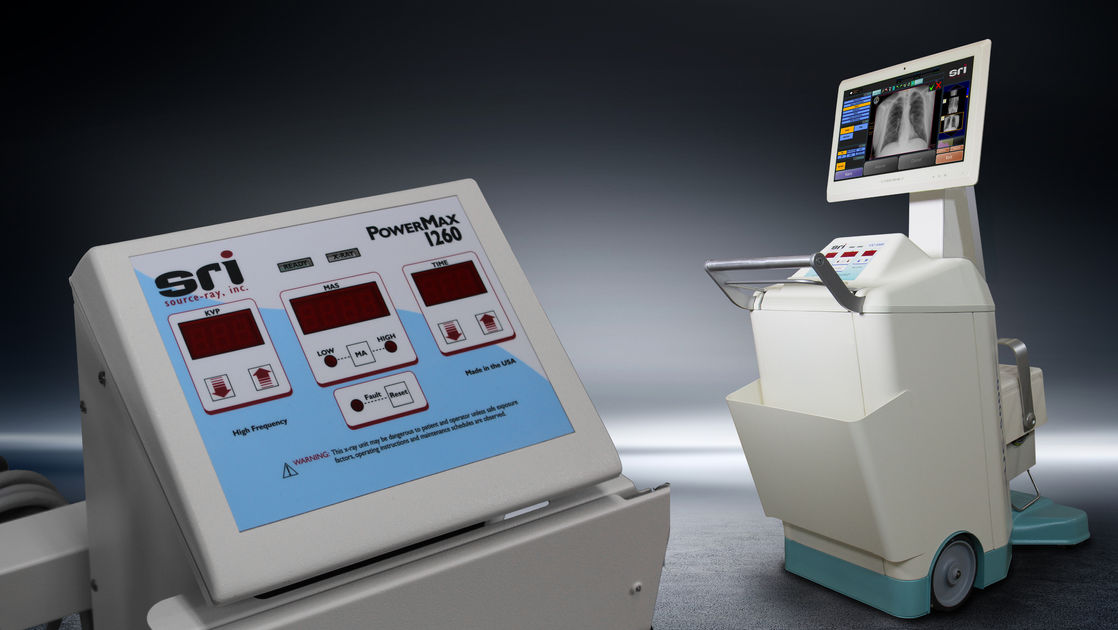
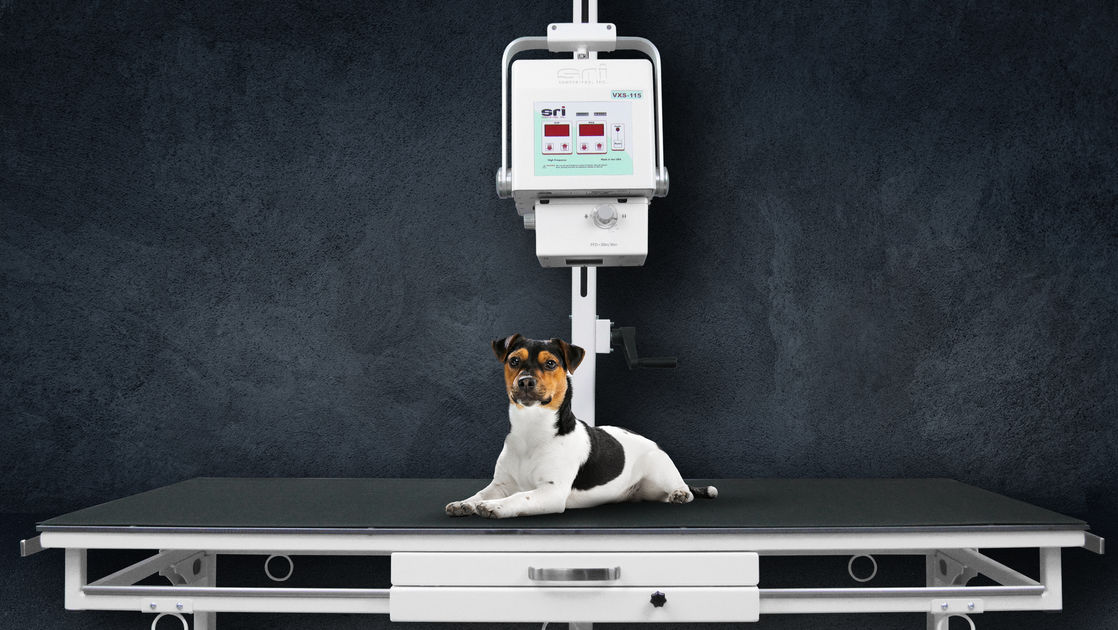
For OEMs developing compact medical imaging equipment, industrial inspection systems, analytical instruments, security systems, or CT platforms, reducing subsystem complexity can be particularly valuable.
3. Create a More Compact X-Ray System Architecture
Space is increasingly valuable in modern equipment.
OEM designers are continually being asked to make systems smaller, lighter, or easier to integrate into automated equipment.
A discrete X-ray architecture requires physical space not only for the X-ray tube and generator but also for high-voltage cables, connectors, minimum cable bend radii, mounting hardware, and appropriate electrical clearances.
An integrated X-ray generator can substantially simplify this packaging challenge.
By incorporating the X-ray tube, high-voltage section, filament supply, and control electronics into one assembly, an integrated generator can provide a cleaner system architecture.
The advantages extend beyond the dimensions of the source itself. Eliminating external high-voltage cabling can also give mechanical engineers greater freedom when laying out detectors, motion systems, shielding, sample handling equipment, and other components around the X-ray source.
For OEM products where every inch of enclosure space matters, integration can therefore become an important design advantage.
4. Match the X-Ray Tube and Generator as a Complete System
An X-ray tube and its generator operate as an electrical system, not as independent components.
The generator must provide stable, controlled tube voltage and tube current while properly controlling the filament and responding appropriately to operating conditions such as arcing. Proper operation is important not only for X-ray output stability but also for protecting the X-ray tube.
With an integrated X-ray generator, the high-voltage electronics can be designed around the electrical characteristics and operating requirements of the specific X-ray tube installed in the assembly.
Tube voltage, tube current, filament control, power limits, arc response, thermal management, and operating sequences can therefore be addressed at the generator level rather than leaving the OEM responsible for matching independently sourced components.
This is particularly important because X-ray tubes are sensitive high-voltage devices. Industry technical literature emphasizes the importance of stable acceleration voltage, controlled filament current, arc management, and appropriate thermal operation in achieving reliable X-ray source performance.
An integrated architecture allows these functions to be developed and validated as a complete X-ray source.
5. Simplify OEM Development, Production, and Support
Perhaps the most overlooked advantage of an integrated X-ray generator for OEMs occurs outside the X-ray exposure itself.
Every additional component incorporated into an OEM product creates additional engineering and operational requirements.
Components must be specified, purchased, qualified, documented, assembled, tested, and supported.
When the tube, high-voltage supply, cabling, and associated interfaces come from separate sources, responsibility for validating the complete X-ray subsystem typically falls more heavily on the OEM.
An integrated generator can simplify that process.
The OEM receives a defined X-ray source assembly with established electrical, mechanical, thermal, and control requirements. This can reduce the amount of subsystem engineering required during development and simplify assembly and testing once the product moves into production.
It also creates a clearer path for technical support. Rather than troubleshooting whether an issue originates with the tube, high-voltage power supply, cable, connector, or interaction among separately sourced components, the OEM can work with the X-ray generator manufacturer at the subsystem level.
For companies developing new X-ray products, these efficiencies can help engineering teams focus more of their resources on the areas that differentiate their equipment, such as imaging, detectors, software, automation, motion control, artificial intelligence, and application-specific functionality.
The Source-Ray Integrated X-Ray Generator for OEMs
Source-Ray designs and manufactures integrated X-ray generators specifically for OEM applications.
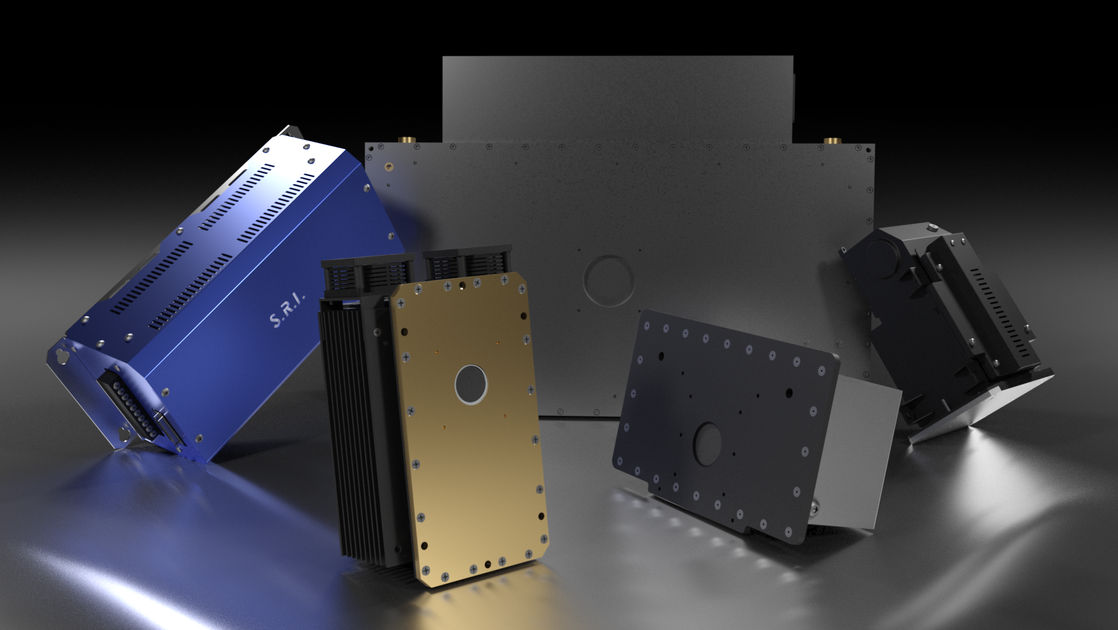
Our integrated SB family combines the X-ray tube and high-voltage generator into a compact assembly, eliminating the external high-voltage cable normally required between a separate generator and packaged X-ray tube.
Source-Ray currently offers integrated generator families ranging from 50 kV through 250 kV, with configurations developed for medical imaging, industrial inspection, pre-clinical imaging, non-destructive testing, analytical research, security, and other OEM applications.
For applications requiring greater power or a different system architecture, Source-Ray also manufactures modular XRS generator platforms. This allows our engineering team to evaluate the requirements of the application rather than forcing every OEM into a single architecture.
Standard Source-Ray generators can also be modified for specific OEM requirements, including electrical, mechanical, control, cooling, and X-ray performance requirements.
Is an Integrated X-Ray Generator Right for Your OEM System?
If your current system uses a packaged X-ray tube connected to a separate high-voltage power supply, the next generation of your product may be an opportunity to reconsider the architecture.
Moving to an integrated X-ray generator can eliminate external high-voltage cabling, reduce the number of components and interfaces within the system, simplify packaging, provide a generator designed around the X-ray tube, and reduce the integration burden placed on your engineering team.
Source-Ray works directly with OEM engineering teams to evaluate existing and new X-ray applications and determine whether one of our standard integrated generators or a customized platform can meet the application’s requirements.
Before designing another X-ray tube, high-voltage power supply, and cable combination into your next system, talk with Source-Ray about what an integrated X-ray generator for OEMs can accomplish.
Frequently Asked Questions About Integrated X-Ray Generators for OEMs
What is an integrated X-ray generator for OEMs?
An integrated X-ray generator for OEMs combines the X-ray tube, high-voltage power supply, filament supply, and related control electronics into one coordinated assembly. This can simplify integration into medical, industrial, analytical, security, and other X-ray systems.
How does an integrated X-ray generator differ from a separate tube and power supply?
A separate architecture uses external high-voltage cables and connectors to connect the X-ray tube to the generator. An integrated X-ray generator places the tube and high-voltage electronics together, reducing external connections and simplifying system packaging.
Why should OEMs consider an integrated X-ray generator?
OEMs may consider an integrated X-ray generator to reduce components, high-voltage cabling, electrical interfaces, packaging requirements, and subsystem integration work. The tube and generator can also be designed and validated as a complete X-ray source.
Can an integrated X-ray generator make an OEM system more compact?
It can. By eliminating external high-voltage cables and consolidating source components, an integrated X-ray generator can provide greater flexibility when designing the enclosure and positioning detectors, shielding, motion systems, and other equipment.
Are integrated X-ray generators suitable for industrial and non-destructive testing systems?
Yes. Integrated X-ray generators can be used in industrial inspection, non-destructive testing, analytical equipment, security systems, medical imaging, research, and other OEM applications, depending on the required voltage, power, duty cycle, cooling, and mechanical configuration.
Does Source-Ray customize integrated X-ray generators for OEM applications?
Source-Ray can modify standard generator platforms for specific OEM requirements, including electrical, mechanical, control, cooling, and X-ray performance requirements. Source-Ray also offers modular generator platforms for applications that require a separate tube and generator architecture.