In the fast-paced world of electronics manufacturing, Surface Mount Technology (SMT) dominates modern production lines. As components become smaller and production speeds increase, manufacturers face a growing challenge: maintaining accurate inventory of thousands of tiny electronic parts. This challenge has made component counting a critical part of SMT inventory management.
Component counting refers to the process of determining the number of individual electronic parts, such as resistors, capacitors, and integrated circuits, contained within SMT component reels. These parts are typically packaged in tape-and-reel formats for automated placement machines used in high-speed electronics assembly.
Traditionally, manufacturers relied on mechanical tape counters that physically unwound the reel and passed the tape through a sensor to count components. While effective for larger components, these systems struggle to keep up with modern electronics manufacturing automation, where components have shrunk to extremely small sizes and production environments demand rapid, reliable inventory verification.
As a result, the industry has increasingly adopted X-ray component counting as the most accurate and efficient solution.
What Is X-Ray Component Counting?
X-ray component counting is a non-destructive method used to determine the number of electronic parts remaining on SMT component reels without physically unwinding the tape. Instead of passing the tape through a mechanical counter, the reel is placed inside an X-ray inspection system.
The machine emits a controlled beam of X-ray radiation that penetrates the layers of plastic or paper tape surrounding the components. This produces a high-resolution X-ray image of the reel's internal structure.
Advanced imaging software then analyzes the image using pattern recognition and machine learning algorithms to identify and count individual components. Within seconds, the system can accurately count thousands of parts.
This approach provides several advantages over traditional counting methods:
● Non-destructive inspection that avoids damaging fragile components
● High-speed automated counting for modern production environments
● Extremely high accuracy, even with ultra-small components
● Improved SMT inventory management and supply chain visibility
For manufacturers running high-volume production lines, this accuracy is essential. Even a small counting discrepancy can lead to line-down events, where a production line stops due to missing components, potentially costing thousands of dollars per hour.
Why X-Ray Inspection Improves SMT Inventory Accuracy
The main reason manufacturers adopt X-ray component counting is precision. Mechanical counters rely on sensors and physical movement, which introduces opportunities for counting errors, misfeeds, or tape damage.
In contrast, X-ray inspection for electronics manufacturing provides a direct visual measurement of the components inside the reel. Because the system analyzes an actual image of the components, it can achieve far higher reliability than mechanical methods.
Additionally, X-ray inspection systems provide a secondary layer of quality control. Operators can visually detect:
● Damaged components
● Misaligned parts within the tape
● Reel inconsistencies
● Packaging defects
This makes X-ray inspection systems valuable not only for counting but also for ensuring component quality before the parts reach the SMT assembly line.
The Critical Role of the X-Ray Source
While operators interact primarily with the software interface of a component counting machine, the true performance of the system is determined by the X-ray source itself.
At the heart of every high-performance counting system is an industrial X-ray generator paired with a microfocus X-ray source. These components determine the clarity, penetration capability, and stability of the imaging system.
For accurate X-ray component counting, the source must produce a stable and precisely controlled beam of radiation. Several factors are critical:
Focal Spot Size
A small focal spot is essential for producing sharp, high-resolution images. If the focal spot becomes too large, the image will blur, making it difficult for software to distinguish individual components, especially on densely packed reels.
Voltage and Current Stability
The industrial X-ray generator must maintain consistent high-voltage output. Fluctuations in voltage or current can create image noise and inconsistent results, reducing counting accuracy.
Penetration capability
Different SMT component reels vary in density depending on component type, packaging material, and reel thickness. The generator must provide sufficient energy to penetrate these layers while still maintaining fine imaging detail.
Because of these requirements, the quality and stability of the X-ray generator ultimately determine whether a system can deliver reliable results in a high-volume production environment.
Industrial X-Ray Generators for Electronics Manufacturing
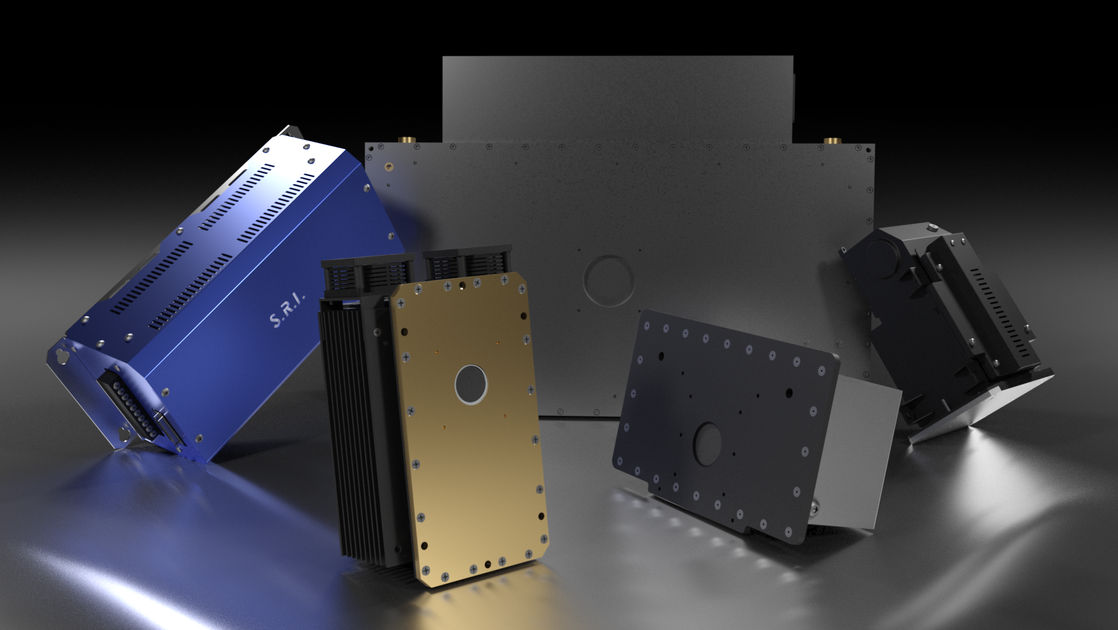
To meet the demands of modern manufacturing environments, companies such as Source-Ray specialize in developing industrial X-ray generators designed for integration into inspection and counting systems.
These generators are engineered specifically for 24/7 electronics manufacturing operations, where reliability and stability are essential. By combining high-voltage performance with microfocus X-ray source technology, these systems provide the precise imaging needed to accurately count even the smallest SMT components.
Compact generator designs also allow machine manufacturers to build smaller, more efficient X-ray component counting systems without sacrificing image quality or inspection power.
For OEM equipment manufacturers and electronics factories alike, this combination of stable X-ray imaging and advanced software analysis enables faster, more reliable inventory verification throughout the production process.
The Future of X-Ray Component Counting
As electronic components continue to shrink and global supply chains grow increasingly complex, accurate SMT inventory management will remain a critical challenge for manufacturers.
The ability to perform high-speed X-ray component counting, often counting thousands of components in under ten seconds, has quickly become an essential capability in modern SMT production environments.
At the center of these systems is the industrial X-ray generator, which provides the stable imaging foundation required for precise inspection and counting.
By combining advanced X-ray inspection technology, intelligent imaging software, and high-performance microfocus X-ray sources, manufacturers can maintain full visibility into their component inventory while keeping production lines running smoothly.
In today’s electronics industry, this integration of physics, imaging technology, and automation is what enables factories to remain efficient, competitive, and ready for the next generation of electronic innovation.