1. Understand the Market Opportunity
Mobile and portable X-ray services address a genuine gap in the healthcare system. Nursing homes, assisted living facilities, hospice organizations, correctional facilities, and home healthcare agencies regularly need X-ray diagnostics, but transporting patients to radiology centers is costly, logistically complex, and often medically risky.
That is where a portable X-ray company steps in. By bringing portable X-ray systems directly to the point of care, you eliminate the need for patient transport, reduce delays in diagnosis, and provide facilities with a fast, reliable imaging solution.

Who are your primary customers?
General Practitioners and Family Medicine Physicians: In-office portable imaging for physician practices and home care visit support
Skilled Nursing Facilities (SNFs): High volume, recurring contracts, consistent revenue
Assisted Living and Memory Care Facilities: A growing segment with underserved imaging needs
Home Health Agencies: Increasing demand for bedside diagnostics
Hospice Providers: Often require on-site imaging for comfort-care decisions
Correctional Healthcare: Captive patient populations with limited transport options
Industrial and Occupational Health Clinics: On-site injury assessment and compliance imaging
Sports Medicine: Game day sideline imaging for professional, semi-professional, collegiate, and high school athletic events, providing rapid on-site assessment for injuries that occur during competition
Special Event Healthcare: On-site diagnostic support for large gatherings such as music festivals, county fairs, and other high-attendance events where portable imaging can provide immediate assessment for injuries and acute conditions
The aging population is a particularly significant tailwind. According to the World Health Organization, the global population aged 60 and older is projected to double by 2050, reaching 2.1 billion, while the number of individuals aged 80 and over is expected to triple between 2020 and 2050. [1] Older adults require significantly more imaging services, and the vast majority live in or transition through the long-term care settings that form the core market for portable X-ray businesses.
2. Know the Regulatory Requirements
Before you make a single imaging call, you need to be properly licensed and compliant. Portable X-ray services are regulated at both the federal and state levels. Getting this right from day one protects your business and builds credibility with facility partners.
Federal / State Requirements
Medicare Part B Supplier Enrollment: Required to bill Medicare for portable X-ray services. Apply through the CMS Provider Enrollment, Chain, and Ownership System (PECOS).
National Supplier Clearinghouse (NSC) Accreditation: CMS requires portable X-ray suppliers to be accredited. Accrediting organizations include the Joint Commission and the Accreditation Commission for Health Care (ACHC).
DMEPOS Supplier Standards: Medicare portable X-ray suppliers must meet specific operational and quality standards outlined by CMS.
State-level requirements
State radiation control program registration for your X-ray equipment
State business license and, depending on your structure, a medical business entity registration
Radiologic technologist (RT) licensing: all operators must hold valid state RT credentials
Schedule a consultation with a local medical physicist and formally register your new portable X-ray system with your state radiological board
PRO TIP
Work with a healthcare compliance attorney or billing consultant who specializes in portable X-ray enrollment. The CMS process is detailed, and delays in accreditation can hold up your revenue by months.
Liability and insurance
You will need professional liability (malpractice) insurance, general commercial liability, commercial auto insurance for your vehicle, and equipment coverage. Most facility contracts will require you to demonstrate adequate coverage before they sign.
3. Choose the Right Portable X-ray Equipment
Your equipment is your business. The quality, reliability, and portability of your portable X-ray systems directly determine the quality of your images, your operational efficiency, and your reputation with clients.
Not all portable X-ray units are the same. Key specifications to evaluate include:
Proven reliability and rugged design: Select a portable X-ray system with a demonstrated track record of reliability in demanding clinical environments. The equipment needs to withstand daily transport, variable conditions, and continuous use. Equally important is ease of service and maintenance; choose a manufacturer with accessible US-based support and readily available parts so downtime is minimized when issues arise
FDA clearance for full-body human radiography: Confirm that the portable X-ray system you are evaluating holds FDA 510(k) clearance for full-body human radiographic use, not just extremity imaging. Some lower-cost units are only cleared for extremities and cannot legally be used for chest, spine, or abdominal studies, the studies that make up the majority of work in long-term care settings
Verified generator output: Verify that rated generator output (kW) is accurate under real clinical conditions. A system labeled as 5 kW that can only sustain that output momentarily, too briefly to produce a quality radiographic image, is not a true 5 kW system. Demand transparent, verifiable specifications before purchasing
Weight and form factor: You are carrying this equipment through nursing home corridors, so compactness matters considerably
Detector compatibility: Flat panel digital detectors deliver superior image quality compared to CR plates
Software and DICOM integration: Images need to flow efficiently to radiologists and into facility EHR systems
Manufacturer support and parts availability: Equipment failure costs you revenue; domestic manufacturers with U.S.-based support offer a significant operational advantage
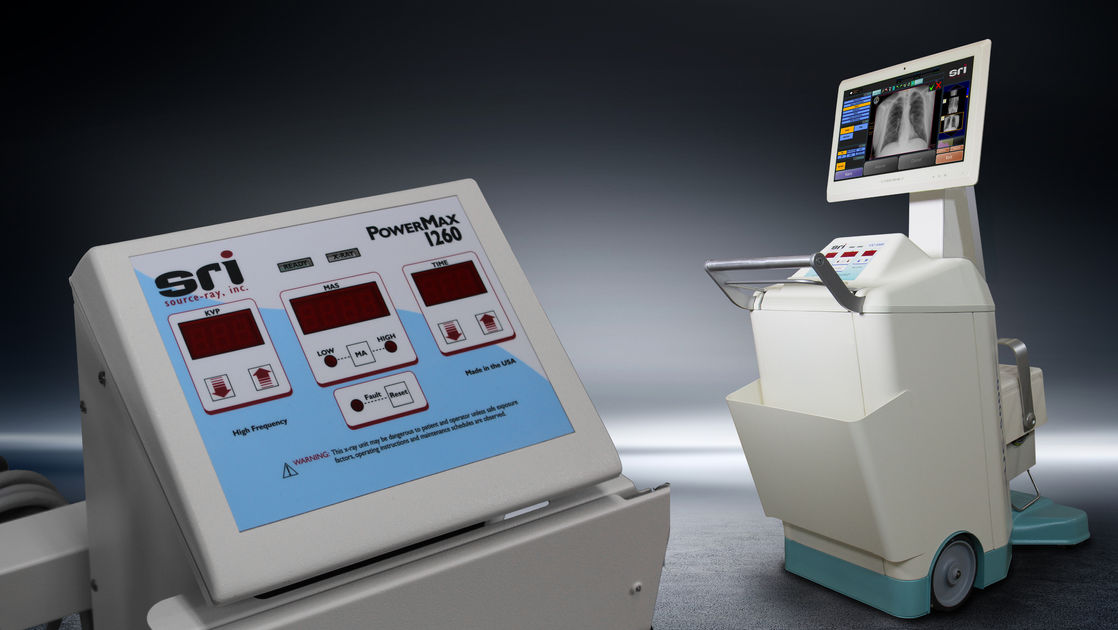
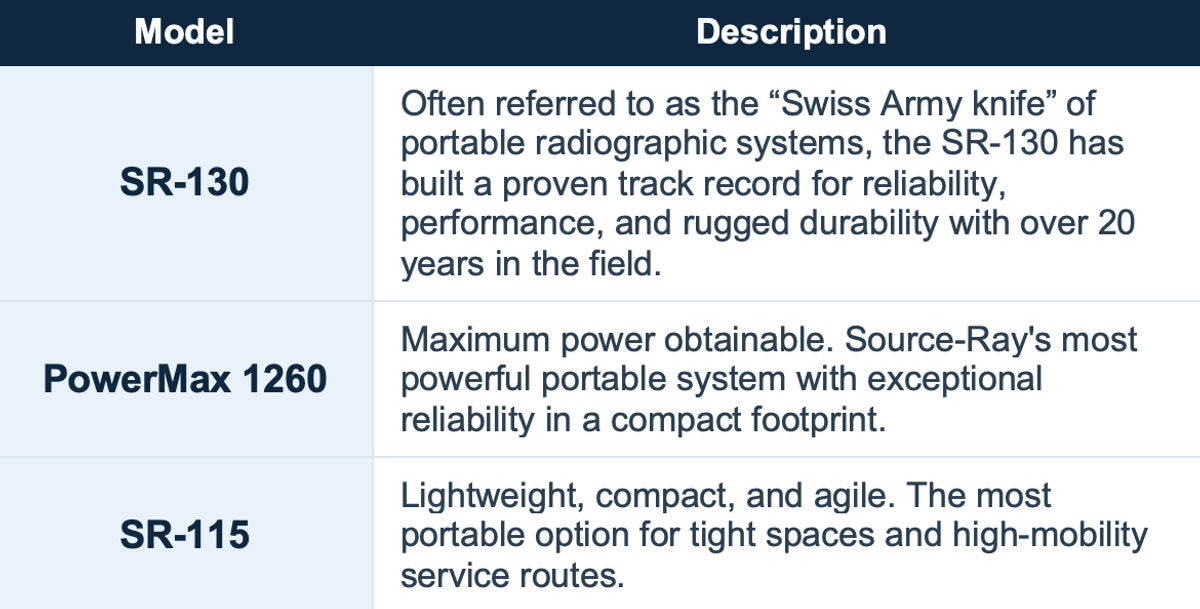
This is where choosing the right manufacturer makes all the difference. Source-Ray designs and manufactures its portable and mobile X-ray systems entirely in the USA, offering field-proven performance, exceptional reliability, and direct U.S.-based support. That matters when your livelihood depends on your equipment being operational every single day.
4. Expand Your Competitive Edge with Additional Modalities
Offering portable X-ray alone is a strong foundation, but the most competitive portable imaging companies expand their service line to include additional diagnostic modalities or other healthcare services that can be provided in a mobile setting. Doing so positions you as a one-stop mobile diagnostics provider for your facility clients, increasing your contract value, improving retention, and differentiating your business from competitors who only offer X-ray. The following modalities and services are the most commonly paired with portable X-ray and represent meaningful opportunities to grow revenue and market share.
Electrocardiograms (ECG/EKG)
Cardiac monitoring is one of the most frequently requested bedside diagnostics in skilled nursing facilities and long-term care settings. A portable 12-lead ECG machine is low-cost, easy to operate, and can be billed independently from X-ray studies, making it one of the highest-return additions to your service line. Offering ECGs gives facilities a reason to consolidate their diagnostic vendors, strengthening your contract position and increasing the frequency of your on-site visits.
Ultrasound: Echocardiograms, Vascular Studies, and Abdominal/Pelvic Scans
Portable ultrasound opens up three high-demand clinical services in a single device. Echocardiograms allow for bedside cardiac function assessment, which is frequently needed in post-acute and skilled nursing settings. Vascular studies, including venous Doppler scans for DVT screening, are commonly ordered for immobile patients. Abdominal and pelvic ultrasound supports evaluation of conditions like ascites, urinary retention, and gallbladder disease. Together, these services make you a significantly more valuable partner to facility clients and allow you to capture diagnostic revenue that would otherwise go to an outside imaging center.
Bone Densitometry (DEXA)
Bone density scanning is an occasionally offered but high-value service, particularly for post-menopausal women and patients at risk for osteoporosis in assisted living and long-term care settings. While not as frequently requested as X-ray or ECG, portable DEXA services can set your company apart in markets where the closest fixed imaging center is far away. Adding this capability demonstrates clinical depth and helps justify longer-term exclusive contracts with larger facilities.
Laboratory Testing Services
Partnering with a certified laboratory or offering laboratory services through a dedicated mobile phlebotomist adds significant value to your mobile diagnostics operation. In skilled nursing, assisted living, and home health settings, routine bloodwork and urinalysis are among the most frequently ordered services. Positioning your company as a one-stop mobile diagnostics provider by combining imaging with lab services makes you considerably more valuable to facility partners and strengthens your contract position.
Mobile Phlebotomy
Mobile phlebotomy, the collection of blood samples at the patient’s location, is one of the most natural services to add alongside portable imaging. The patient populations you already serve require regular blood draws for medication management, chronic disease monitoring, and pre-procedure testing. Adding mobile phlebotomy increases your per-visit revenue, drives higher visit frequency, and opens standalone phlebotomy contracts with facilities that may not require imaging on every visit. This service can be delivered by a trained phlebotomist on your team or by a technologist who holds phlebotomy credentials.
5. Build Your Service Model
There are two dominant service structures for portable X-ray companies. Choose the one that fits your capital situation and growth goals, or combine both over time.
Model A: Fee-per-study billing
You bill Medicare, Medicaid, or private insurance directly for each study performed. This requires your own CMS supplier enrollment and accreditation but gives you the highest revenue per study. This model suits operators who want full business independence and are willing to invest in billing infrastructure.
Model B: Facility contracts (per-study or per-visit)
You contract directly with nursing homes and other facilities, who pay you a flat rate per study or per scheduled visit. The facility handles its own billing. This model is faster to launch, more predictable, and ideal for building your initial client base without waiting on CMS enrollment.
Many successful portable X-ray companies start with Model B to build revenue and facility relationships, then layer in direct Medicare billing once accreditation is secured.
OPERATIONAL NOTE
Plan your routes geographically from day one. Clustering your facility contracts within defined zones dramatically reduces drive time, increases daily study volume, and improves your per-mile economics.
6. Set Up Your Technology Stack
Efficient operations require more than good equipment. The right software infrastructure determines how quickly images reach radiologists, how seamlessly you integrate with facility workflows, and how smoothly you get paid.
Teleradiology service: Partner with a board-certified radiology read service for fast, reliable remote reads. Turnaround times of 1 to 4 hours can be a major competitive differentiator with facilities.
PACS and image management: A cloud-based PACS system allows you to store, route, and share DICOM images with radiologists and facilities securely.
Portable flat panel detector: Pair your X-ray generator with a high-quality flat panel digital detector for immediate digital image acquisition at the bedside.
Medical billing software: Essential if you are billing insurers directly. Dedicated medical billing software or a third-party billing service handles claim submission, rejection management, and payment posting.
Scheduling and dispatch software: As volume grows, route management and scheduling tools prevent double bookings and optimize your technologist's time.
7. Win Your First Facility Contracts
Your first five to ten facility contracts are the hardest and the most important. Here is how operators consistently land them.
Lead with a problem they already have
Every Director of Nursing at a skilled nursing facility has the same headache: sending a frail resident to an outside imaging center takes hours, requires transport costs, disrupts care, and carries real clinical risk. Your pitch is simple: you eliminate all of that.
Walk in with a proposal, not a brochure
Facilities respond to specifics. Come with a written proposal that outlines your response time SLA, image turnaround time, your equipment credentials, liability insurance documentation, and your per-study or per-visit pricing structure.
Start with Director-of-Nursing referrals
Directors of Nursing and Administrators talk. A single strong relationship at one facility, backed by reliable service, generates referrals to sister properties and neighboring facilities faster than any sales call.
Build an online presence early
Facility administrators search for portable X-ray providers online. A clean, professional website with service area information, credentials, and clear contact information significantly increases inbound inquiries, especially as you build your local market reputation.
8. Staff and Scale Strategically
In the early stages, many portable X-ray companies operate with a single owner-technologist handling all studies. This works and keeps overhead low. As volume grows, the path to scaling is straightforward:
Add a second technologist before you max out your personal capacity. Losing a facility contract because you could not cover a shift is an expensive and avoidable mistake.
Add a second vehicle and unit once your first route is consistently full. Two technologists running parallel routes can double your study volume without doubling overhead proportionally.
Bring billing in-house when you are billing Medicare directly. As study volume grows, the economics of a dedicated biller or billing software become compelling compared to outsourcing.
Expand your service territory by identifying adjacent markets: new geographic zones, new customer segments like home health, or additional modalities such as EKG or bone density that leverage your existing relationships and infrastructure.
EQUIPMENT PLANNING TIP
When budgeting for your second unit, consider upgrading your primary unit to a higher-power model like the PowerMax 1260 and deploying your original unit as a backup or second-route system. Source-Ray's consistent product architecture makes cross-training technologists straightforward.
9. Financial Planning and Revenue Expectations
A portable X-ray is a relatively low overhead business with strong unit economics once routes are established. Here is a realistic framework for your first year.
Startup costs to plan for
Portable X-ray system (equipment and detector): primary capital investment
Vehicle (hatchback, small crossover, or SUV suitable for equipment transport)
Accreditation fees (ACHC or Joint Commission) and CMS enrollment costs
State radiation license and equipment registration fees
Liability and commercial auto insurance (annual premiums)
PACS software, teleradiology contract, and billing infrastructure
Revenue model
A typical portable X-ray technologist can complete 8 to 15 studies per day on an established route. At competitive market rates for direct facility contracts, or at higher rates under direct Medicare billing, this creates a strong revenue base from a lean operation with one technologist, one vehicle, and one quality portable X-ray unit.
FINANCIAL NOTE
This guide provides a general framework. Revenue will vary by market, billing model, payer mix, and operational efficiency. Consult with a healthcare financial advisor and billing specialist for projections specific to your market.
Consider Joining the APDA
The APDA is a non-profit trade organization representing providers who deliver diagnostic services directly at the patient’s bedside. Its primary focus is bringing medical imaging and testing directly to the frail, elderly, and disabled in nursing homes, assisted living facilities, and private residences. Membership gives your business access to resources that can accelerate your growth and help you navigate the complexities of operating in this space. Member benefits include access to industry-specific billing and compliance guidance, legislative and regulatory advocacy on behalf of portable diagnostic providers, a member directory that helps facility administrators find accredited providers in their area, educational webinars and training resources, and peer networking with other portable imaging operators across the country. For new entrants especially, APDA membership signals credibility to facility partners and adds professional standing that can differentiate your company during contract evaluations. Learn more at apdahealth.com/content.asp?contentid=207.
The Bottom Line
Starting a portable X-ray company is a legitimate, growing business opportunity, and one that makes a real difference in the quality of care patients receive. The barriers to entry are real: regulatory compliance, capital investment, clinical credentialing. But they also protect the businesses that clear them. Once established, you will serve a client base with consistent, recurring imaging needs that grows with every contract you sign.
REFERENCES
World Health Organization. (2024). Ageing and Health. Retrieved from who.int/news-room/fact-sheets/detail/ageing-and-health
Mordor Intelligence. (2025). Portable X-ray Devices Market: Size, Share and Trends Analysis Report (2025-2030). Retrieved from mordorintelligence.com
GM Insights. (2025). Portable X-ray Devices Market Size and Forecast, 2025-2034. Retrieved from gminsights.com