Understanding Mini Focus, Microfocus, and Nanofocus X-ray Technology
A microfocus X-ray generator is an X-ray source engineered to produce exceptionally high-resolution images by generating a very small focal spot on the X-ray tube target. By concentrating the electron beam onto a highly controlled area of the anode, microfocus technology minimizes geometric unsharpness and enables extremely fine internal features to be resolved with outstanding clarity.
Compared to conventional X-ray generators, microfocus X-ray generators provide significantly higher spatial resolution, making them ideal for applications such as electronics inspection, battery analysis, additive manufacturing, scientific research, industrial computed tomography (micro-CT), and other forms of high-resolution non-destructive testing (NDT).
As a general engineering guideline, many reflection-target microfocus X-ray tubes are designed to operate at approximately one watt of target power per micron of focal spot size. Actual operating performance varies depending on X-ray tube design, target material, cooling method, and overall system architecture.
Why Focal Spot Size Matters
The focal spot is the area of the X-ray tube target where the accelerated electron beam strikes the anode and generates X-rays. Focal spot size is one of the primary factors affecting image resolution, geometric magnification, and edge sharpness.
Smaller focal spots reduce geometric unsharpness and penumbral blur, allowing greater image magnification while preserving fine detail. As focal spot size decreases, however, the allowable tube current must also decrease to maintain acceptable thermal loading on the target. Consequently, high-resolution X-ray systems require careful balancing of focal spot size, X-ray output, cooling capacity, and overall imaging performance.
Mini Focus, Microfocus, and Nanofocus X-ray Generators
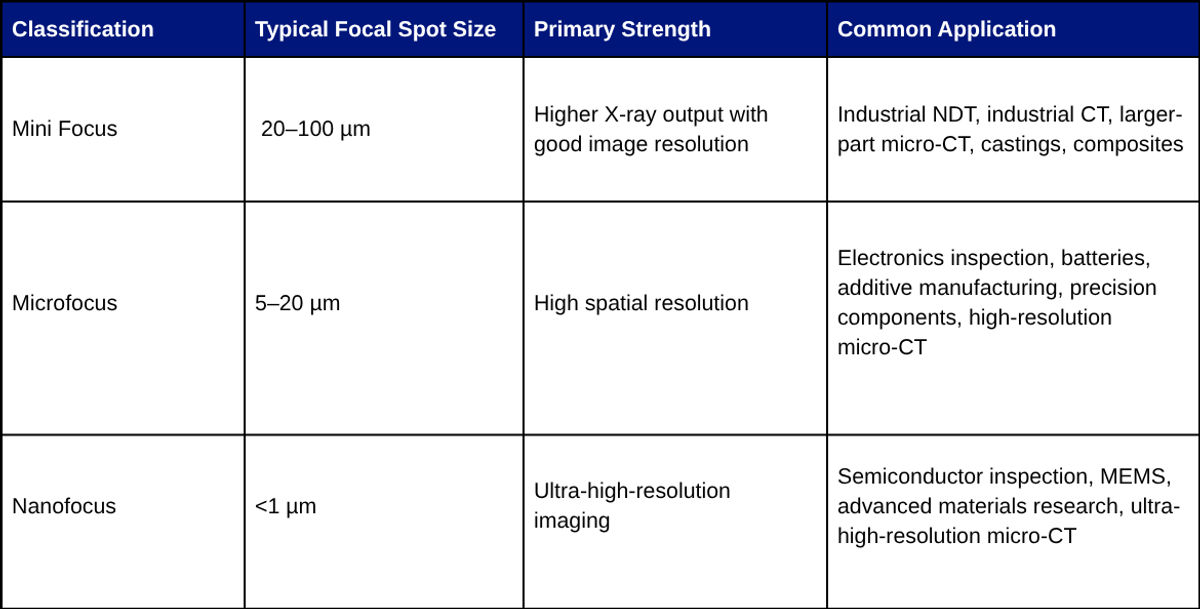
For the purposes of this article, X-ray generators are grouped into three focal spot categories based on the imaging performance they are designed to deliver. These classifications provide a practical framework for comparing X-ray technologies used throughout industrial inspection, electronics manufacturing, scientific research, and micro-CT imaging.
Mini Focus X-ray Generators
Mini focus X-ray generators typically utilize focal spot sizes ranging from approximately 20 to 100 microns.
These systems provide an excellent balance between X-ray output power and image resolution, making them well suited for applications requiring both image quality and inspection throughput. Because larger focal spots can dissipate more heat, mini focus generators generally operate at higher power levels than microfocus systems, enabling faster inspection speeds and improved penetration for larger or denser components.
Typical applications include:
Industrial non-destructive testing (NDT)
Industrial computed tomography (CT)
Larger-part micro-CT imaging
Weld inspection
Castings
Composite materials
Automotive components
Aerospace components
General quality assurance
Automated production inspection
Mini focus X-ray generators are often selected when inspection speed, X-ray output, and long-term reliability are equally as important as image resolution.
Microfocus X-ray Generators
Microfocus X-ray generators typically utilize focal spot sizes ranging from approximately 5 to 20 microns.
Reducing the focal spot into this range significantly improves spatial resolution and allows extremely small internal features to be visualized with minimal geometric blur. These systems are widely used whenever high-detail imaging is required while maintaining practical X-ray output.
Common applications include:
Printed circuit board inspection
Semiconductor packaging
Battery inspection
Additive manufacturing
Aerospace components
Precision machined parts
Failure analysis
High-resolution micro-CT imaging
Scientific research
Microfocus X-ray generators represent an ideal balance between ultra-high image resolution and practical X-ray output, making them one of the most versatile technologies available for precision inspection.
Nanofocus X-ray Generators
Nanofocus X-ray generators achieve focal spot sizes of less than one micron.
These systems produce exceptional image resolution capable of resolving sub-micron structures that cannot be visualized using conventional X-ray sources. Maintaining these extremely small focal spots requires highly stable electron optics, precision mechanical alignment, sophisticated thermal management, and advanced control electronics.
Nanofocus X-ray generators are commonly used for:
Semiconductor inspection
MEMS inspection
Advanced materials research
Failure analysis
Ultra-high-resolution micro-CT imaging
Academic research
Laboratory imaging
Because nanofocus systems prioritize ultimate image resolution over X-ray output power, they are generally used for specialized laboratory and research applications rather than high-throughput industrial inspection.
Selecting the Appropriate X-ray Generator
Choosing between a mini focus, microfocus, or nanofocus X-ray generator depends on the application's imaging requirements, including:
Required image resolution
Desired geometric magnification
Material density
Sample size
Inspection speed
X-ray output power
Duty cycle
Cooling method
System integration requirements
It is important to recognize that applications such as computed tomography (CT) and micro-CT are not defined solely by focal spot size. Depending on the desired image resolution, specimen size, detector characteristics, and geometric magnification, micro-CT systems may successfully utilize mini focus, microfocus, or nanofocus X-ray generators.
For example, larger specimens may be effectively imaged using a mini focus X-ray generator, while higher-resolution systems often benefit from microfocus technology. Nanofocus X-ray generators are typically reserved for applications requiring visualization of sub-micron features or the highest achievable spatial resolution.
Selecting the appropriate X-ray generator therefore requires balancing focal spot size with X-ray output, image quality, inspection speed, and overall system performance.
The Future of High-Resolution X-ray Imaging
Demand for higher-resolution X-ray imaging continues to grow across industrial manufacturing, electronics inspection, battery development, semiconductor manufacturing, scientific research, and micro-CT imaging.
Continued advances in electron beam control, thermal management, target design, and precision manufacturing are enabling progressively smaller focal spots while improving long-term stability and imaging performance. As these technologies continue to evolve, mini focus, microfocus, and nanofocus X-ray generators will remain foundational technologies supporting the next generation of industrial inspection, scientific discovery, and advanced imaging.
Conclusion
Understanding the relationship between focal spot size and imaging performance is essential when selecting an X-ray generator for any high-resolution imaging application.
Mini focus, microfocus, and nanofocus X-ray generators each provide distinct advantages depending on the required balance between image resolution, X-ray output, inspection speed, and system complexity. Selecting the appropriate technology allows engineers, researchers, and OEM system designers to optimize imaging performance while meeting the unique requirements of their application.
At Source-Ray, we design and manufacture high-performance X-ray generators for OEM, industrial, scientific, and medical imaging applications. Our mini & microfocus portfolio includes X-ray generators with focal spot sizes ranging from approximately 33 microns for high-performance industrial & laboratory imaging to advanced 20-micron and 8-micron microfocus platforms, as well as custom OEM solutions engineered for specialized applications.
Our engineering and technical sales teams work closely with customers to recommend the most appropriate X-ray generator based on focal spot size, operating voltage, power output, duty cycle, cooling method, system integration requirements, and imaging objectives.
Whether your application involves industrial inspection, electronics manufacturing, non-destructive testing (NDT), computed tomography (CT), micro-CT imaging, scientific research, or another specialized imaging challenge, Source-Ray has the engineering expertise and product portfolio to help identify the optimal X-ray solution.